
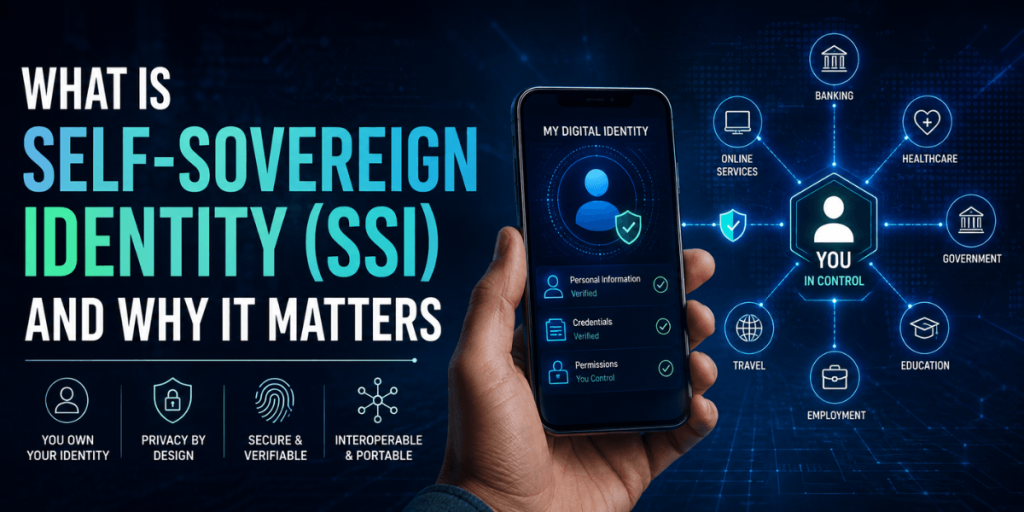
Your identity is yours. At least, it should be. Yet every time you verify your age or log into a service, your personal data ends up in someone else’s database. That’s the reality of traditional identity systems. The future of identity verification systems points toward a different path, one where you hold the keys to your own information. This idea has gained attention as data breaches expose millions of records every year.
Traditional systems store personal data in centralized databases, making them attractive targets for hackers. This new model flips that approach. It uses blockchain and cryptography to give users ownership of their identity data.
Understanding Self-Sovereign Identity (SSI)
To grasp SSI, you first need to understand how it differs from the systems we use today. Self-sovereign identity is a digital model where you control your personal information without relying on a central authority. You hold your credentials in a secure digital wallet on your phone. When you need to prove something, you share only what is necessary. It cuts the risk of identity theft and puts real ownership of your data back in your hands.
Traditional identity systems fall short because they are administrative silos. Your driver’s license, passport, and student ID come from different organizations. Each has its own separate system. Your information is scattered across databases you cannot control. When you change your address, you must update every system individually. This fragmented approach creates security problems and frustrates users.
How Self-Sovereign Identity Works in Practice
The technology behind SSI is simpler than it sounds when you break down the key components.
The Technology Behind SSI
SSI uses decentralized identifiers, or DIDs, which you own and control without a central authority. Every DID has a private and public key pair. The private key lets you sign documents and give consent. The public key lets others verify your credentials through the blockchain.
The Trust Triangle
SSI operates on a trust triangle involving the issuer, holder, and verifier. You present your credentials to a trusted third party for verification. Blockchain records each transaction in a distributed, publicly visible chain. This makes alterations nearly impossible to detect.
Verifiable Credentials
A verifiable credential is the digital version of a physical document like a driver’s license. The issuer creates and digitally signs the credential for you to store. Anyone can verify its authenticity by checking the issuer’s DID on the blockchain.
Selective Disclosure
Selective disclosure lets you share only specific information from a credential. For example, you can prove you are over 21 without revealing your birthdate. This minimizes the personal information you expose and protects your privacy.
Verifiable credentials rely on trust and accuracy. At IDpapa, we build both into every identification solution. For anyone wanting to buy a fake driver’s license, we are the trusted choice. Get in touch today for dependable service!
The Benefits of Self-Sovereign Identity
Moving control back to individuals creates advantages that go beyond just convenience.
- You Control Your Data: You decide what to share, with whom, and for how long. No central authority holds your data. This reduces the risk of large data breaches.
- Improved Security: Your data is not stored in centralized honeypots. Your credentials are cryptographically signed and verified on the blockchain. Your private keys stay protected.
- Portability Across Services: Your identity works across different platforms and services. You are not locked into any single provider. Use your verified credentials anywhere.
- Privacy by Design: Data stays on your device and is shared only with your consent. No personal information is stored in central repositories. This addresses growing concerns about data misuse.
Is Self-Sovereign Identity Secure?
The answer comes down to how it’s built. SSI uses strong cryptography to keep your data safe. Your private keys stay on your own device and never leave it. This means hackers can’t steal your identity from a single central place, because there is no single place to attack.
Blockchain adds another layer of protection. It records every action in a way that can’t be changed later. When someone checks your ID, the system looks at the issuer’s record on the blockchain. This makes faking a credential very difficult.
But security also depends on you. If you lose your private keys, you lose access to your identity, just like losing a physical wallet. This system gives you full control. That’s both its biggest strength and its biggest responsibility.
How to Use Decentralized Identity?
A digital wallet on your phone stores your verified credentials. You request these credentials from trusted issuers, like a government office or a bank. They check your information and issue a digital credential signed with their private key.
When you need to prove something about yourself, you open your wallet and share only what’s needed. For example, you can prove you’re over 21 without sharing your birthdate or address. The verifier checks the issuer’s signature on the blockchain to confirm it’s real, all in seconds, without contacting the issuer directly. You stay in control the whole time.
Comparing SSI to Traditional Identity Systems
Here’s how the two models stack up across the areas that matter most.
| Feature | Traditional Identity | Self-Sovereign Identity |
| Data Control | Owned by a central authority | Owned and controlled by you |
| Privacy | Stored in centralized databases | Stored on your own device |
| Security | Vulnerable to data breaches | Secured with cryptography and blockchain |
| Portability | Tied to one provider | Works across platforms |
| Consent | Often buried in terms and conditions | Requires explicit consent |
| Disclosure | Usually requires full documents | Allows selective disclosure |
Frequently Asked Questions
1. What is self-sovereign identity (SSI) in simple terms?
SSI is a digital identity model where you own and control your personal information. Instead of companies storing your data in their databases, you keep your credentials in a secure digital wallet on your phone. You decide what to share, with whom, and when.
2. How does SSI differ from traditional identity systems?
Traditional systems store your identity data in centralized databases controlled by organizations. SSI stores data on your device and uses blockchain technology for verification. You control your information rather than trusting organizations to protect it. You can also share only specific details rather than entire documents.
3. What are the key benefits of decentralized identity for users?
Users gain complete control over their personal information. They can share only what is necessary with each service provider. Their data is not stored in vulnerable centralized databases. They can use the same verified identity across multiple platforms without creating separate accounts everywhere.
4. How does blockchain support self-sovereign identity?
Blockchain provides a tamper-proof public ledger for recording decentralized identifiers and verifying credentials. When an issuer creates a credential, their DID is recorded on the blockchain. Anyone can verify the credential’s authenticity by checking the issuer’s DID without contacting the issuer directly.
5. Is self-sovereign identity secure?
SSI is considered secure because it uses strong cryptography and eliminates the risks of centralized data storage.
Conclusion
Self-sovereign identity represents a fundamental shift in how we manage digital identification. It shifts control away from centralized authorities and places it in the hands of individuals. Real deployments exist today, with airport systems and digital wallets leading the way. The core idea is simple: you should own your identity. This is not just a technical upgrade. It is a new way of thinking about who we are in the digital world.
Control over your identity means having options that work for you. At IDpapa, we are committed to providing reliable identification. For those seeking a scannable fake ID, we set the standard. Connect with us today and experience excellence!